Introduction: Before “Religion” Had a Name
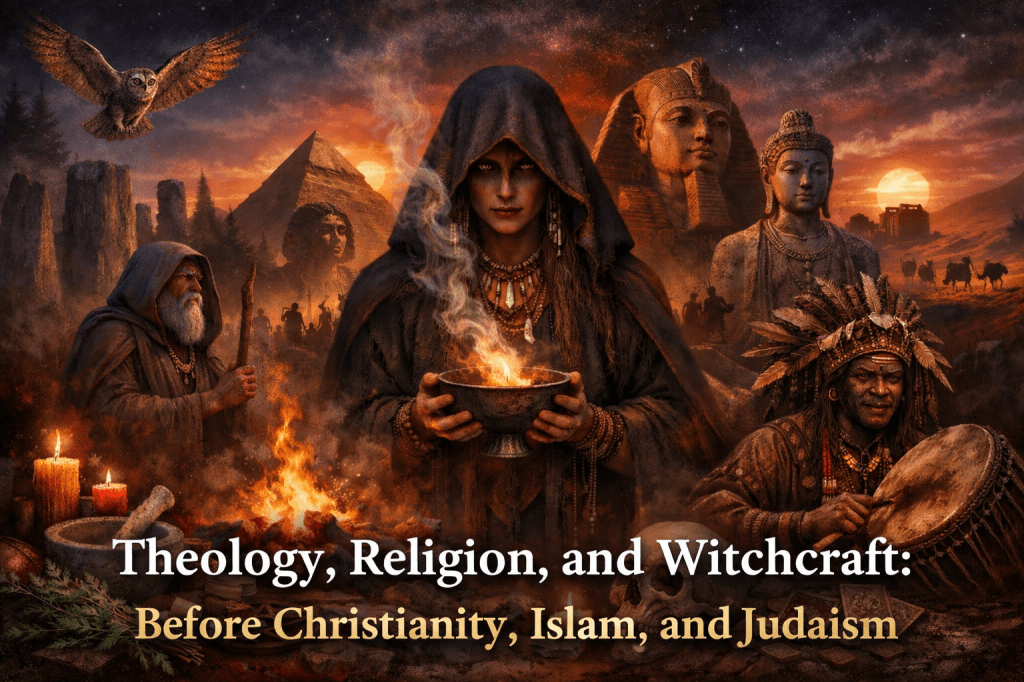
Long before structured belief systems like Christianity, Islam, or Judaism took hold, humanity was already deeply spiritual. There were no “official” doctrines, no centralized scriptures, no institutional clergy—yet people had powerful systems to explain life, death, nature, and the unseen.
What we now label as religion, theology, or even witchcraft didn’t exist as separate categories. They were one and the same: a unified worldview rooted in survival, observation, and connection to forces beyond human control.
What Was Theology Before Organized Religion?
Theology today is often tied to formal study—books, doctrines, and institutions. But in the pre-Christian, pre-Islamic, and pre-Judaic world, theology was lived, not studied.
It looked like this:
- The sky wasn’t just “weather”—it was intention, power, presence
- Illness wasn’t random—it had spiritual cause
- Dreams weren’t imagination—they were messages
- Death wasn’t an end—it was a transition
Early theology was experiential. It wasn’t debated in classrooms—it was practiced in daily life.
Religion Without Institutions
What we now call “religion” existed everywhere—but without churches, mosques, or synagogues.
Instead, there were:
- Sacred groves instead of temples
- Elders and shamans instead of priests
- Oral traditions instead of written scripture
- Rituals tied to seasons, hunting, fertility, and survival
There was no separation between sacred and ordinary life. Everything was spiritual.
Witchcraft: The Original Applied Spiritual Science
Before it was demonized, “witchcraft” was simply practical spirituality.
It included:
- Herbal medicine
- Energy healing
- Ritual protection
- Divination (reading signs, stars, or patterns)
- Communication with ancestors or spirits
The people practicing these arts weren’t “outcasts”—they were essential to their communities. They were healers, advisors, and interpreters of the unseen.
What changed? Later religious systems reframed these practices as dangerous or forbidden—not because they were new, but because they competed with centralized authority.
Global Expressions of Early Spiritual Systems
Africa
- Ancestor veneration
- Spirit mediation
- Nature-based cosmology
Europe (Pre-Christian)
- Celtic druids
- Norse seers (Volva)
- Ritual magic tied to land and seasons
Asia
- Early forms of what became Taoism, Shinto, and Vedic traditions
- Harmony with nature and cosmic balance
Americas
- Mayan, Aztec, and Indigenous North American spiritual systems
- Deep integration of astronomy, ritual, and nature
Different cultures. Same pattern: connection, balance, and respect for unseen forces.
The Turning Point: Rise of Organized Religion
As civilizations grew, something shifted.
Spiritual systems became:
- Codified into written texts
- Controlled by centralized authority
- Standardized into doctrine
- Policed for “correct belief”
Practices once seen as normal—like spirit communication or herbal healing—were rebranded as:
- Heresy
- Sorcery
- Witchcraft (in a negative sense)
This wasn’t just theological—it was political. Control belief, and you control people.
Witchcraft vs Religion: A Manufactured Divide
Originally, there was no divide.
The split came later:
| Early World | Later Systems |
|---|---|
| Unified spirituality | Segmented belief systems |
| Nature-centered | Institution-centered |
| Experiential | Doctrine-driven |
| Local authority | Centralized authority |
What we call “witchcraft” today is often just surviving fragments of older spiritual systems.
What This Means Today
Modern spirituality is circling back.
People are:
- Reconnecting with nature
- Exploring ancestral traditions
- Questioning institutional authority
- Blending structured religion with personal spirituality
This isn’t new—it’s a return.
Final Thought: Before Labels, There Was Connection
Before theology became academic, before religion became institutional, and before witchcraft became controversial—there was a simple idea:
Human beings are not separate from the universe—they are part of it.
Everything else came later.