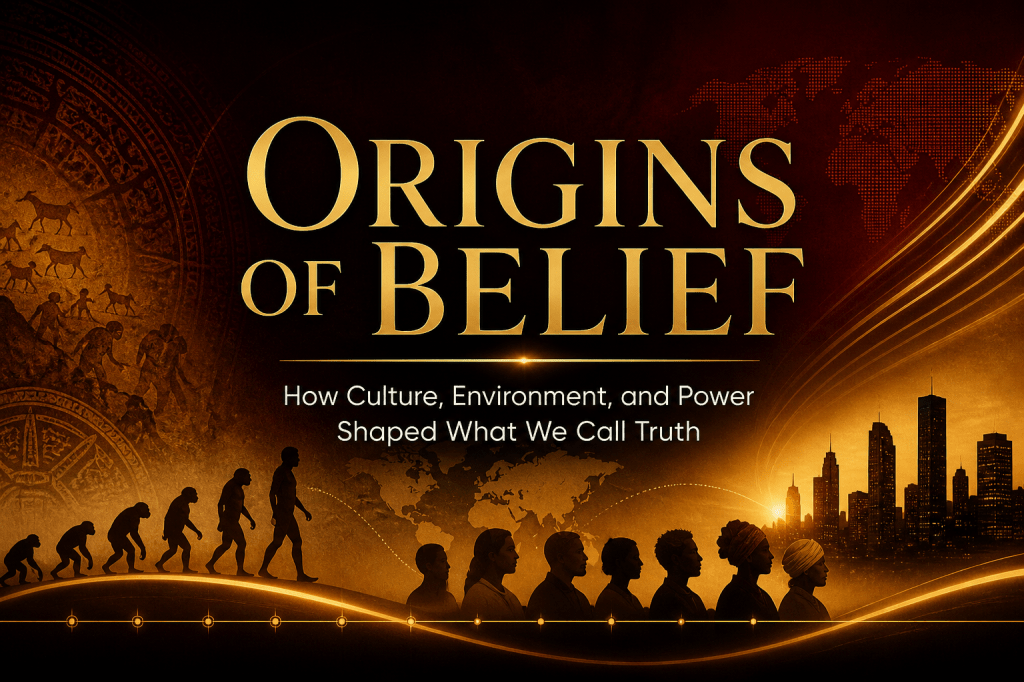
How Culture, Environment, and Power Shaped What We Call Truth
Introduction: Belief Didn’t Appear—It Developed
Belief systems didn’t fall from the sky fully formed.
They were built.
Long before organized religion, doctrine, or sacred institutions, human beings were trying to answer the same fundamental questions:
- Where did we come from?
- What controls life and death?
- What happens after we die?
The answers weren’t universal.
They were local, cultural, and shaped by environment.
👉 Belief evolved.
The First Beliefs: Observation, Not Doctrine
Early humans didn’t follow scriptures.
They followed patterns.
They watched:
- The rising and setting of the sun
- The changing of seasons
- Birth, growth, decay, and death
- The movement of stars and natural forces
From this came early conclusions:
- Life is cyclical
- Nature holds power
- There is an unseen force behind what we see
This wasn’t religion.
This was interpretation of reality through experience.
Culture Became the Filter
As societies formed, beliefs began to shift—not because truth changed, but because perspective did.
Different environments produced different understandings:
- Desert cultures emphasized survival, law, and order
- River civilizations focused on fertility, cycles, and abundance
- Tribal societies emphasized ancestors and lineage
- Warrior cultures elevated gods of power, conquest, and protection
👉 Same questions. Different answers.
Why?
Because culture shaped doctrine.
Power and Control Enter the Equation
At some point, belief stopped being just explanation—and became structure.
Leaders recognized something critical:
👉 If you control belief, you influence behavior.
This is where belief systems began to formalize into:
- Rules
- Laws
- Moral codes
- Hierarchies
Religious authority became tied to political authority.
Doctrine became less about discovery…
…and more about control, stability, and influence.
From Fluid Thought to Fixed Doctrine
Early belief systems were flexible.
They adapted, evolved, and absorbed new understanding.
But institutional religion did the opposite.
It locked belief into fixed systems:
- Canonized texts
- Defined “truth” vs “heresy”
- Established authority structures
- Limited interpretation
What started as exploration became enforcement.
The Illusion of Absolutes
Modern belief systems often present themselves as:
- Final
- Complete
- Unquestionable
But history tells a different story.
Every belief system:
- Emerged in a specific place
- Was shaped by specific people
- Responded to specific conditions
👉 That means belief is influenced.
Not absolute.
What This Means Today
Understanding the origins of belief does something powerful:
It breaks the illusion that any one system holds exclusive ownership of truth.
Instead, it reveals:
- Belief is constructed
- Doctrine is influenced
- Truth is often interpreted through culture
This doesn’t destroy belief.
It frees it.
Conclusion: Expanding the Lens
When you step back, the pattern becomes clear:
Belief systems are not isolated truths.
They are evolving responses to human experience.
👉 The question is no longer: What should I believe?
👉 The question becomes: How was this belief formed—and why?
That shift changes everything.
“Belief is not just inherited—it is shaped, influenced, and constantly evolving.”